
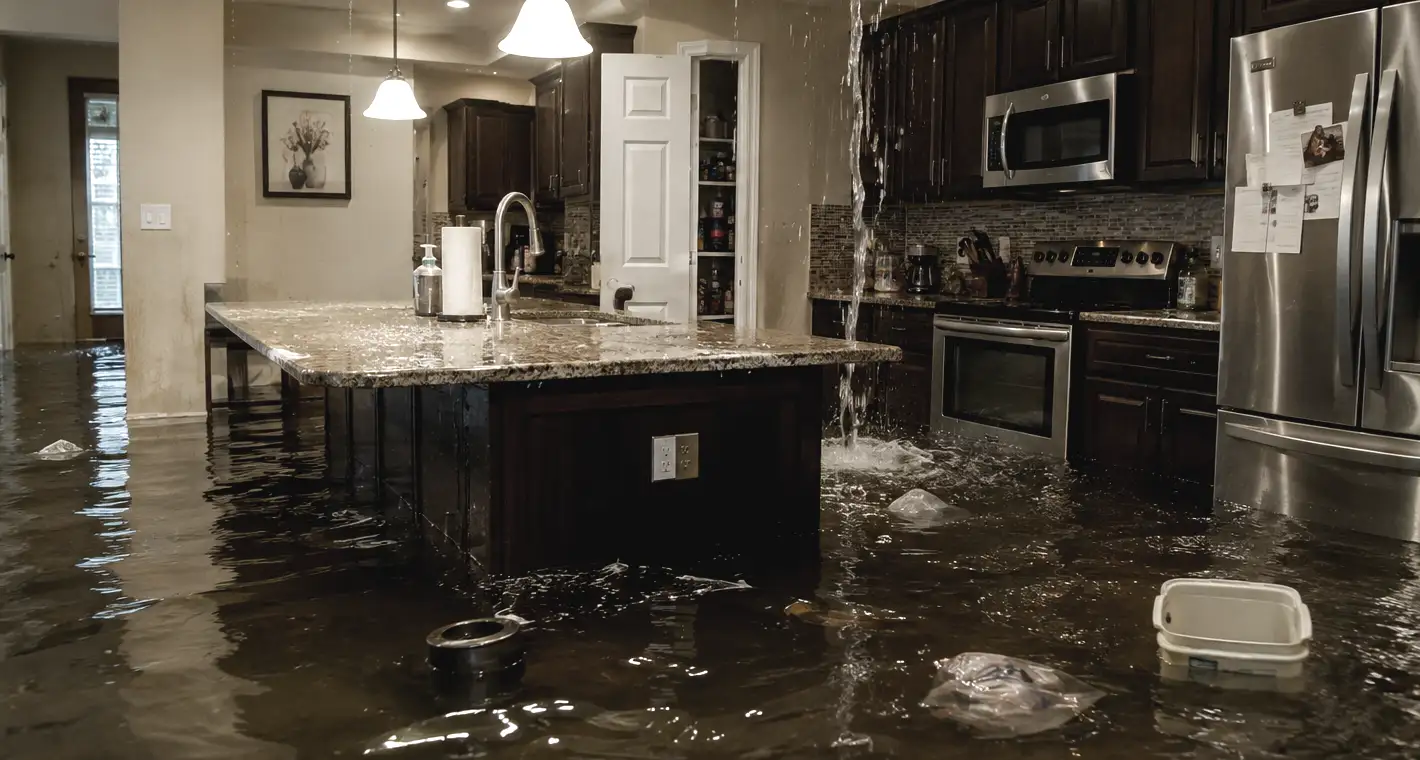
Water damage in Springville
Springville lies south of Provo where Hobble Creek comes out of its canyon, and the creek runs through the middle of the older part of the city. Springville has a notable stock of historic homes near Main Street, some with stone or rubble foundations, alongside newer subdivisions to the east and south.
Those two facts shape most of the water losses that happen here. Where a house sits, how old it is, and what its plumbing and drainage were designed for determine both how water gets in and where it travels once it does. Water follows gravity and capillary action rather than room boundaries, so a failure on an upper floor of a Springville home routinely damages rooms that are nowhere near it.
Before help arrives
- Shut the water off at the fixture or the main if you can reach it safely.
- Keep out of any room where water has reached outlets, cords, or the electrical panel.
- Lift furniture off wet carpet and move what you can to a dry floor.
- Photograph the damage and the failure point before anything is moved.
- Do not use a household vacuum to pick up standing water.
Common causes in Springville
Hobble Creek and its floodplain
Properties along the creek corridor are the first affected in a high-runoff year. Even where the creek stays in its banks, the water table beneath nearby homes rises with it, and basements that are dry most years take on seepage.
Historic homes with original plumbing
Houses near the historic center may still carry their original drain and supply runs. Cast iron drain stacks corrode from the inside and can fail inside a wall, and old shutoff valves frequently will not close when they are finally needed.
Stone and rubble foundations
Older foundations of stone or unreinforced masonry are porous in a way poured concrete is not. They wick moisture rather than shedding it, and drying them takes longer and needs different equipment than a modern basement.
Spring runoff off the east bench
Snowmelt from the slopes above the city concentrates in the drainages that cross the older neighborhoods, and window wells on the uphill side of a house take the brunt of it.
Drying a Springville home
Historic Springville homes often have board subfloor over joists rather than sheet goods, and balloon framing that lets water travel between floors inside the wall. That means the wet area is regularly larger than it looks, and the search for where water actually went takes longer than the drying itself.
The sequence itself does not change from house to house: extraction first, then air movers and dehumidifiers working together, with moisture readings logged each day until the affected materials match the dry baseline for that building. It is described in full on the water extraction and drying page.
Services available in Springville
- Water Extraction & DryingStanding water removed, structure dried under moisture readings.
- Basement Flood CleanupGroundwater, sump failure, window wells and plumbing losses.
- Sewage CleanupContaminated water, handled with containment and removal.
- Mold RemediationGrowth that followed water left in the structure too long.
- Burst pipe and supply line cleanup
- Water heater and appliance leak cleanup
- Ceiling and drywall water damage
- Moisture inspection and mapping
Areas covered in Springville
Providers cover Springville and the surrounding area, including Historic Springville, Hobble Creek, Spring Creek, West Fields, Bartholomew and Canyon Road.
ZIP codes: 84663.
Frequently Asked Questions
- Will my homeowners insurance cover water damage?
- It depends on the cause rather than the damage. Policies commonly cover sudden and accidental events such as a burst supply line, a failed water heater, or an appliance hose that lets go. Damage that developed gradually from a long-standing leak, and damage from surface flooding, are typically handled differently or excluded. Photograph everything before anything is moved or removed, keep any failed part, and report the loss to your insurer promptly, because most policies require you to take reasonable steps to prevent further damage.
- Should I turn off the electricity?
- If water has reached outlets, cords, appliances, or the panel itself, treat the area as unsafe. Only shut off the breaker if you can reach the panel without standing in water and without touching anything wet. If you cannot reach it safely, leave the area and have the utility or an electrician handle it. No amount of property is worth a shock hazard.
- My house has original cast iron drain stacks. What usually fails there?
- The stack corrodes from the inside, thinning at the base where waste sits longest, and the joints at branch connections loosen. Failure inside a wall shows up as a stain or a smell rather than visible water, and by then the framing around it has usually been damp for some time. Age past roughly sixty years is where these start to appear.
- Hobble Creek is running high. Does that matter if I am not on the bank?
- It can. The water table under the older part of the city rises with the creek, so properties a street or two away see seepage without any surface flooding. On stone or rubble foundations that shows as damp along the base of the wall, since those masonry types wick moisture rather than shedding it.
- The old shutoff valve will not close. What do I do in the meantime?
- Go to the next valve upstream, which usually means the main at the meter, and shut there instead. Gate valves of that age seize open and can break if forced. Locate the main and confirm it turns before you need it, because finding out during a failure is how a contained loss becomes a whole-floor one.
- My basement has a stone foundation. Does that change the drying plan?
- It usually does. Stone and older masonry hold a great deal more water than poured concrete and release it slowly, so readings that look acceptable on the surface can be misleading. Drying a space like that generally takes longer, and a technician may want to monitor it over several days rather than pull equipment as soon as the finish materials read dry.