
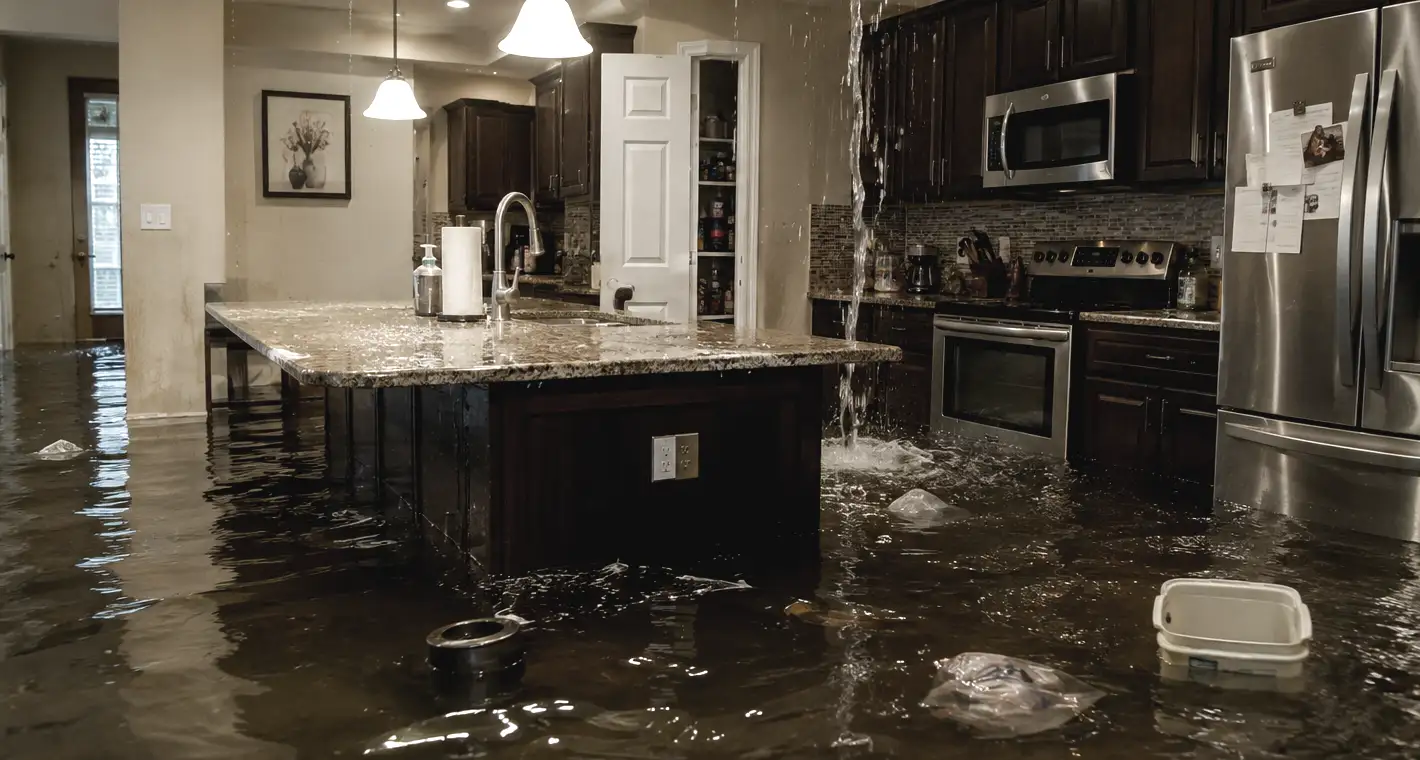
Water damage in Spanish Fork
Spanish Fork sits at the mouth of Spanish Fork Canyon, where the Spanish Fork River leaves the mountains, and the canyon wind that comes with that location is a defining feature of the city. An older core near Main Street is surrounded by substantial newer growth to the south and east toward Maple Mountain.
Those two facts shape most of the water losses that happen here. Where a house sits, how old it is, and what its plumbing and drainage were designed for determine both how water gets in and where it travels once it does. Water follows gravity and capillary action rather than room boundaries, so a failure on an upper floor of a Spanish Fork home routinely damages rooms that are nowhere near it.
Before help arrives
- Shut the water off at the fixture or the main if you can reach it safely.
- Keep out of any room where water has reached outlets, cords, or the electrical panel.
- Lift furniture off wet carpet and move what you can to a dry floor.
- Photograph the damage and the failure point before anything is moved.
- Do not use a household vacuum to pick up standing water.
Common causes in Spanish Fork
Canyon wind and wind-driven rain
The wind out of Spanish Fork Canyon is strong enough to lift shingle courses and drive rain horizontally under flashing. Roof leaks that begin this way are intermittent, appearing only when wind and rain arrive together, which makes them easy to dismiss until the ceiling below is already saturated.
Proximity to the Spanish Fork River
Homes in the river bottoms sit on ground with a higher water table and are more exposed during years of heavy runoff from the Diamond Fork and Thistle drainages.
Wind-scoured roofs and ice damming
The same wind that strips snow off some roof faces leaves it piled deep on others. Uneven snow load combined with heat loss from the attic produces ice dams that back water up under the shingles and into the wall cavity.
Irrigation lines through older neighborhoods
Long-standing irrigation infrastructure runs through the older parts of the city. Lines that were adequate for orchards run close to houses that were built later.
Drying a Spanish Fork home
The canyon wind that defines Spanish Fork also affects drying: doors and windows left open to help usually do the opposite, pulling humid outside air through the space. Drying here is done with the building closed and dehumidification carrying the load, which is worth knowing before you set up fans yourself.
The sequence itself does not change from house to house: extraction first, then air movers and dehumidifiers working together, with moisture readings logged each day until the affected materials match the dry baseline for that building. It is described in full on the water extraction and drying page.
Services available in Spanish Fork
- Water Extraction & DryingStanding water removed, structure dried under moisture readings.
- Basement Flood CleanupGroundwater, sump failure, window wells and plumbing losses.
- Sewage CleanupContaminated water, handled with containment and removal.
- Mold RemediationGrowth that followed water left in the structure too long.
- Burst pipe and supply line cleanup
- Water heater and appliance leak cleanup
- Ceiling and drywall water damage
- Moisture inspection and mapping
Areas covered in Spanish Fork
Providers cover Spanish Fork and the surrounding area, including Historic Downtown, Palmyra, Canyon View, River Bottoms, Maple Mountain, Sunset Ridge and Spanish Oaks.
ZIP codes: 84660.
Frequently Asked Questions
- Will my homeowners insurance cover water damage?
- It depends on the cause rather than the damage. Policies commonly cover sudden and accidental events such as a burst supply line, a failed water heater, or an appliance hose that lets go. Damage that developed gradually from a long-standing leak, and damage from surface flooding, are typically handled differently or excluded. Photograph everything before anything is moved or removed, keep any failed part, and report the loss to your insurer promptly, because most policies require you to take reasonable steps to prevent further damage.
- Should I turn off the electricity?
- If water has reached outlets, cords, appliances, or the panel itself, treat the area as unsafe. Only shut off the breaker if you can reach the panel without standing in water and without touching anything wet. If you cannot reach it safely, leave the area and have the utility or an electrician handle it. No amount of property is worth a shock hazard.
- The wind stripped snow off half my roof and piled it on the other. Is that a problem?
- It is one of the more common winter causes here. Uneven snow load combined with heat escaping through the attic melts the underside of the drift, and the meltwater refreezes at the cold eave. The resulting ice dam backs water up under the shingles and into the wall cavity, where it can run for weeks before a stain appears inside.
- I live in the river bottoms. What changes in a wet spring?
- The water table under the property rises with the Spanish Fork River even when the river itself stays inside its banks. Basements that are dry most years can seep along the cold joint or around the slab perimeter, usually showing first as a damp perimeter rather than standing water. Runoff from Diamond Fork and Thistle is what drives the worst years.
- Rain only gets in when the wind blows. Where should someone look first?
- At the windward elevation, and specifically at flashing, window head details and the first courses of shingles above them. Wind-driven rain travels sideways and upward, so it defeats details that shed ordinary rainfall perfectly well. A leak that appears during a storm and dries between storms points at the envelope rather than at plumbing.
- How do I tell a wind-driven roof leak from a plumbing leak?
- Timing is the clearest signal. A roof leak that only appears during or shortly after a windstorm, and dries out between events, points to the building envelope. A plumbing leak generally does not care about the weather and either runs continuously or tracks with fixture use. If a stain grows while the weather is dry, the source is more likely to be inside.