
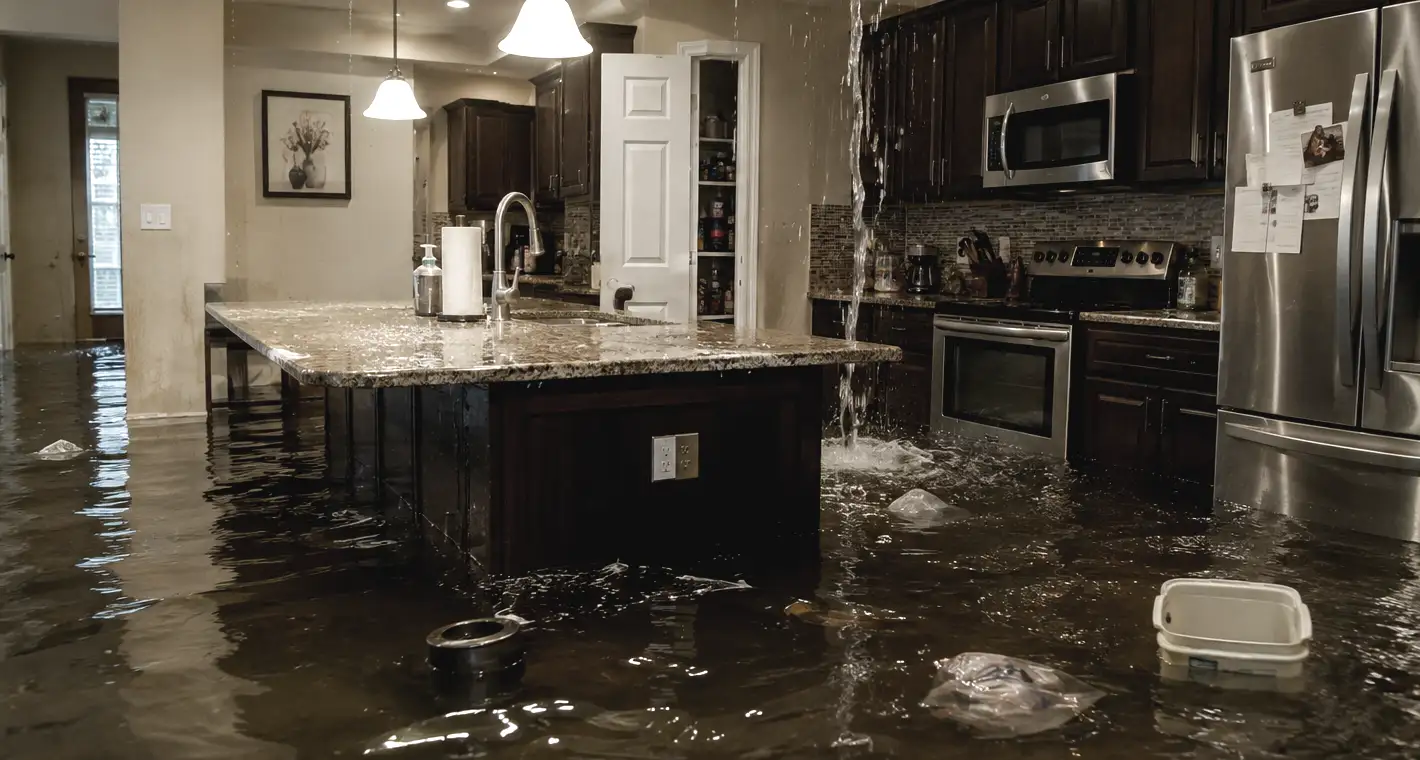
Water damage in Payson
Payson sits at the southern end of Utah County below Payson Canyon, with Peteetneet Creek running through the older part of town. Payson holds some of the oldest housing in the south county, including Victorian-era homes near the historic center, along with newer development on the west side.
Those two facts shape most of the water losses that happen here. Where a house sits, how old it is, and what its plumbing and drainage were designed for determine both how water gets in and where it travels once it does. Water follows gravity and capillary action rather than room boundaries, so a failure on an upper floor of a Payson home routinely damages rooms that are nowhere near it.
Before help arrives
- Shut the water off at the fixture or the main if you can reach it safely.
- Keep out of any room where water has reached outlets, cords, or the electrical panel.
- Lift furniture off wet carpet and move what you can to a dry floor.
- Photograph the damage and the failure point before anything is moved.
- Do not use a household vacuum to pick up standing water.
Common causes in Payson
Original plumbing in historic homes
Houses near the historic center may be a century old or more. Where they have not been repiped, supply and drain lines are well past their design life, and failures inside walls and under floors are common. Shutoff valves of that age often cannot be closed when they are needed.
Payson Canyon runoff
The canyon above town drains quickly during spring melt and summer storms. Water crossing the older streets finds window wells and basement entries in the historic grid, where grading was established long before modern drainage standards.
Aging sewer infrastructure
Older mains and laterals in the historic part of the city are more prone to backup, which brings contaminated water into basements rather than clean water.
Irrigation through established neighborhoods
Long-standing irrigation ditches and lines run through parts of town that were farmland when the system was laid out, and they now pass close to houses.
Drying a Payson home
The oldest Payson houses have lath and plaster, board subfloor and sometimes no continuous vapour barrier under the bottom floor. Materials of that age are slower to dry and much harder to replace in kind, so more time goes into drying them in place rather than removing and rebuilding.
The sequence itself does not change from house to house: extraction first, then air movers and dehumidifiers working together, with moisture readings logged each day until the affected materials match the dry baseline for that building. It is described in full on the water extraction and drying page.
Services available in Payson
- Water Extraction & DryingStanding water removed, structure dried under moisture readings.
- Basement Flood CleanupGroundwater, sump failure, window wells and plumbing losses.
- Sewage CleanupContaminated water, handled with containment and removal.
- Mold RemediationGrowth that followed water left in the structure too long.
- Burst pipe and supply line cleanup
- Water heater and appliance leak cleanup
- Ceiling and drywall water damage
- Moisture inspection and mapping
Areas covered in Payson
Providers cover Payson and the surrounding area, including Historic Downtown, Peteetneet, West Payson, Loafer View, Nebo and Canyon Road.
ZIP codes: 84651.
Frequently Asked Questions
- Will my homeowners insurance cover water damage?
- It depends on the cause rather than the damage. Policies commonly cover sudden and accidental events such as a burst supply line, a failed water heater, or an appliance hose that lets go. Damage that developed gradually from a long-standing leak, and damage from surface flooding, are typically handled differently or excluded. Photograph everything before anything is moved or removed, keep any failed part, and report the loss to your insurer promptly, because most policies require you to take reasonable steps to prevent further damage.
- Should I turn off the electricity?
- If water has reached outlets, cords, appliances, or the panel itself, treat the area as unsafe. Only shut off the breaker if you can reach the panel without standing in water and without touching anything wet. If you cannot reach it safely, leave the area and have the utility or an electrician handle it. No amount of property is worth a shock hazard.
- My hundred-year-old house has never been repiped. What is most likely to go?
- Galvanised supply lines corroding from the inside and thinning at the threaded joints, and cast iron drains failing at the base of the stack. Both fail inside walls and floors rather than in the open. Shutoff valves of the same age frequently will not close when they are finally needed, which is worth testing before there is an emergency.
- Runoff from Payson Canyon crosses my street each spring. How do I keep it out?
- Work on the approach rather than the house. Keep the gutter line and any street-side drain clear, make sure the grade at the front of the property does not funnel water toward the walk, and cover or raise window wells on the uphill side. The historic grid was laid out before modern drainage standards, so the surface path matters more here than in newer parts of town.
- An irrigation ditch runs behind my property. Could that be why the basement is damp?
- It could, and it is easy to overlook because the timing does not match rainfall. Long-standing ditches and lines in this part of town were laid out when the land was farmed, and they now run close to houses built later. They are charged through the warm months, so a basement that is damp all summer and dry in winter points at irrigation rather than at weather.
- The house is over a hundred years old. Does that complicate the work?
- It adds considerations rather than obstacles. Older homes may have plaster over lath, board subfloors, balloon framing that lets water travel between floors inside the wall cavity, and finishes that are not easily replaced. A technician working on a house of that age normally spends more time locating where the water actually went, because it does not stay where it lands the way it does in modern construction.